
What Probate Covers in Attala County Chancery Court
Probate is the court process that settles what a person leaves behind. In Mississippi, that process lives in the Chancery Court, the state's court of equity. Attala County's Chancery Court hears estates of people who have died, with or without a will. It also handles guardianships, conservatorships, settlements paid to minors, and commitments of people who cannot care for themselves. The county's official courts page lists these duties plainly, alongside adoptions, land issues, and domestic matters.
The Chancery Court is not the same as the Circuit Court. The Circuit Court hears felonies and large civil lawsuits. Chancery handles the equity side of county life, which is where wills and estates belong. Two chancellors are listed locally for this district, the Hon. Joseph Kilgore and the Hon. Kiley Kirk. The Mississippi Judiciary keeps a plain summary of this jurisdiction on its Chancery Court overview page, which mirrors how the court works in Kosciusko.
Estate and guardianship files often run for years. They open when someone files, and they close only after the court signs a final order.
Probate Terms Defined
Probate paperwork uses words most people meet only once or twice in a lifetime. A short glossary helps before reading any file. The terms below show up across petitions, orders, and accountings filed with the Chancery Clerk.
- Testator
- The person who made the will. When a testator dies, the will is offered to the Chancery Court to be proved valid.
- Executor
- The person named in the will to carry it out. Once approved, the executor receives letters testamentary and acts for the estate.
- Intestate
- Dying without a valid will. State law then decides who inherits, and the court appoints an administrator instead of an executor.
- Guardianship
- A court arrangement where one person is given legal authority over a minor or over a minor's property.
- Conservatorship
- A similar arrangement for an adult who cannot manage personal or financial affairs because of age, illness, or disability.
How to Search Attala County Chancery Court Records
There is no separate free probate search portal for Attala County. Estate and guardianship cases route through Mississippi Electronic Courts, the statewide e-filing and case-management system that now covers Chancery, Circuit, and County Courts. Public viewing runs through the PAMEC access component, which asks for a login and may carry a subscription or per-page charge. The no-cost fallback is the public terminal at the Chancery Clerk counter during business hours.
The fields below describe how a probate lookup is framed inside the electronic system. Several options were not visible publicly, so treat the table as a guide rather than a confirmed screen. The official entry point is the Mississippi Electronic Courts page.
| Field Label | Type | Required | Notes |
|---|---|---|---|
| Court | Dropdown / selection | Yes | Choose Chancery Court / Attala County within the system. |
| Case number | Text | Optional | Best input if known; exact format not captured. |
| Decedent / party name | Text | Optional | Search by estate or decedent name where allowed. |
| Filing date range | Date | Optional | Availability not confirmed publicly. |
| Case type | Dropdown | Optional | Probate, estate, guardianship, or conservatorship; options not fully visible. |
For older or non-digitized matters, the clerk counter remains the surest path. Records from before electronic filing may exist only on paper indexes.
How Probate Works in Attala County
Every estate follows a rough order, even when the details differ. The steps below trace a typical case from the first filing to the closing order. Each one passes through the Chancery Clerk, who keeps the file and dockets the court's actions.
- File a probate or estate petition in Chancery Court through the Chancery Clerk in Kosciusko.
- Provide the will, death information, heir and beneficiary details, and the proposed fiduciary's information as required.
- The court reviews the filing and, if approved, issues orders and letters that name the executor or administrator.
- The fiduciary gives required notices, handles creditor claims, inventories estate property, and seeks authority for any sales or distributions.
- The fiduciary files accountings or final closing documents and obtains a discharge or an order closing the estate.
- For a guardianship or conservatorship, expect extra restrictions because the file may hold minor, medical, and financial information.
Note: Most estates need a licensed attorney to file and move through Chancery Court, so confirm representation requirements with the clerk before starting.
The Attala County Chancery Court and Chancery Clerk
The Chancery Clerk is the office that opens, stores, and certifies probate files for the county. In Attala County that clerk is Taylor Casey, who serves the Sixth Chancery District court in Kosciusko. The same office records deeds, liens, and board minutes, so probate sits beside the county's land and equity records. A fuller profile of the office and its duties appears on the Attala County Chancery Clerk page.
Attala County Chancery Clerk
230 West Washington Street
Kosciusko, MS 39090
662-289-2921
Fax: 662-289-7662
Email: tcasey@attalacounty.net
Mon–Fri 8:00 a.m.–5:00 p.m.
Call before a visit to confirm how a file is requested and whether a copy can be pulled the same day. The clerk can also explain which records are open and which require authorization.
Probate Filing Fees in Attala County
Attala County does not publish a probate fee schedule in its official online materials. No estate, guardianship, conservatorship, certified-copy, or search amount was located for the county, so no figure is listed here. Publishing another county's numbers as Attala's would be wrong, and fees change over time. The reliable answer is to call the Chancery Clerk and ask for the current cost before filing or requesting copies.
| Item | Amount |
|---|---|
| Original probate or estate filing | Call Chancery Clerk, 662-289-2921 |
| Letters testamentary or administration | Call Chancery Clerk for current cost |
| Certified copy per page | Call Chancery Clerk for current cost |
| Guardianship or conservatorship filing | Call Chancery Clerk for current cost |
| MEC / PAMEC online viewing | Subscription and possible per-page charge |
Mississippi's Public Records Act allows public bodies to charge reasonable, actual-cost fees for searching and copying, and to collect them in advance. That framework covers non-case county records held by the clerk.
What Attala County Probate Records Contain
An estate file is a collection, not a single document. It grows as the case moves, and the clerk adds each new filing in order. Reading one tells the story of how an estate was opened, managed, and closed. The items below are the parts a probate file may hold.
- Petition to probate a will or to open an estate.
- The original or a copy of the will, where one was filed.
- The order admitting the will or opening an administration.
- Letters testamentary or letters of administration.
- Notice to creditors and the proof of publication.
- Inventory and appraisement, plus claims filed against the estate.
- Accountings, vouchers, receipts, distribution orders, and the closing order.
Guardianship and conservatorship files add their own layers. They often include bonds, annual accountings, evidence of capacity, and orders protecting a minor or a protected adult. Minor settlement cases include the petition approving how money paid to a child is held.
Restricted Guardianship and Conservatorship Records
Not every probate document is open to the public. Guardianship and conservatorship files often hold medical and capacity evidence, financial account details, and information about minors. Mississippi's records law lets the clerk separate and redact protected material before releasing the rest. Adoption files handled by the Chancery Court are restricted, and so are commitment proceedings for people who cannot care for themselves.
Records that name minors, list financial accounts, or contain medical and capacity evidence may be sealed or redacted. Expect the Chancery Clerk to ask about your authority to view a guardianship or conservatorship file.
The county also takes part in a juvenile treatment program tied to the Chancery bench. The Mississippi Judiciary announced the Sixth Chancery District Youth Drug Court for Attala, Neshoba, and Winston Counties.
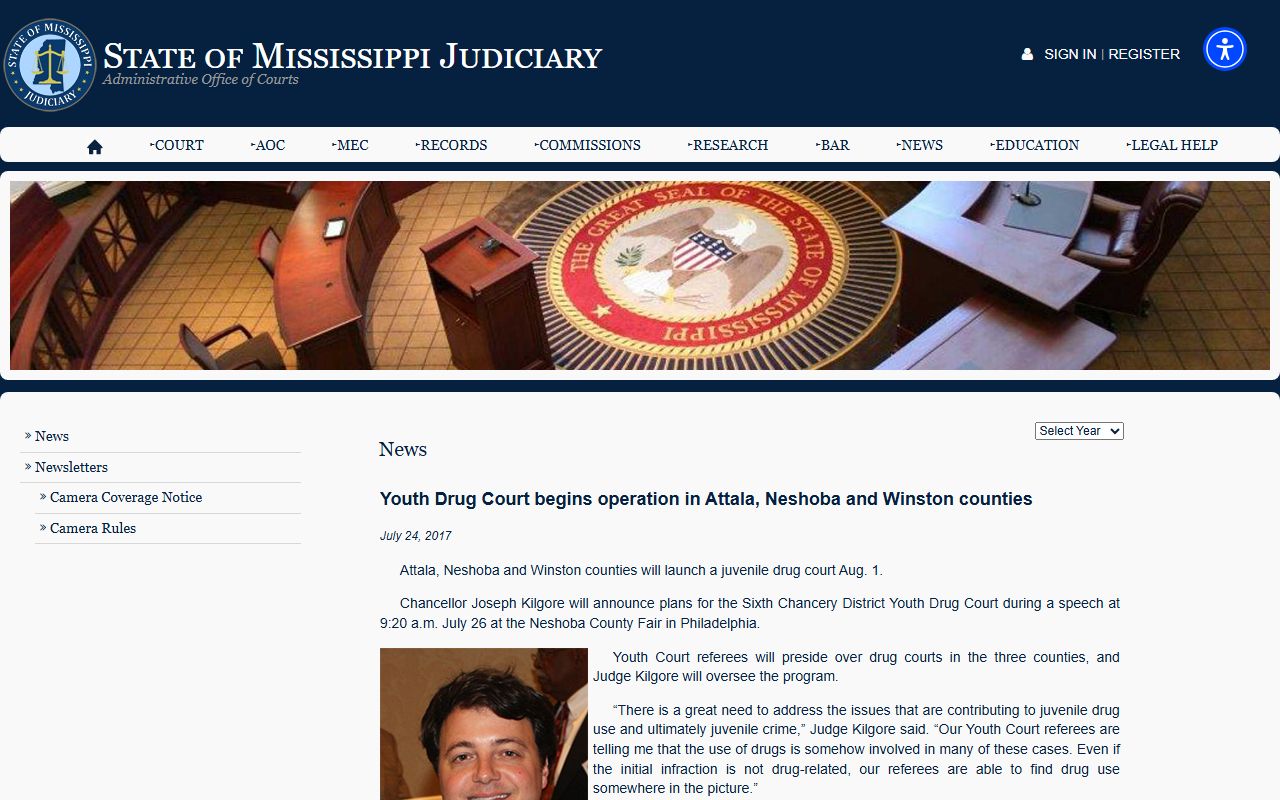
Records from that youth program involve juvenile cases, so they sit outside the ordinary public docket and are not open to general lookup.
Older Probate Files at the Chancery Clerk
Many Attala County estate matters predate electronic filing. Mandatory attorney e-filing reached the local Chancery Court in 2017, and statewide electronic filing finished only recently. Anything filed before then may live only on paper, indexed in books at the courthouse. For those cases, the clerk counter is the starting point, not the online system.
When you contact the office, bring as much detail as you can. The case name, the decedent's name, an approximate date of death, and a rough filing year all speed the search. You can request a file in person, by phone, or in writing, and you can ask for certified copies for legal use. The county's official courts page lists current contacts for the Chancery Court and its sister courts.
Probate and family matters often overlap. A reader tracing a divorce alongside an estate can use the county's marriage and divorce records as a companion path, since both run through the same Chancery Clerk.
Note: Certified copies, not plain printouts, are what courts and title companies usually accept, so ask for certification when a copy must carry legal weight.